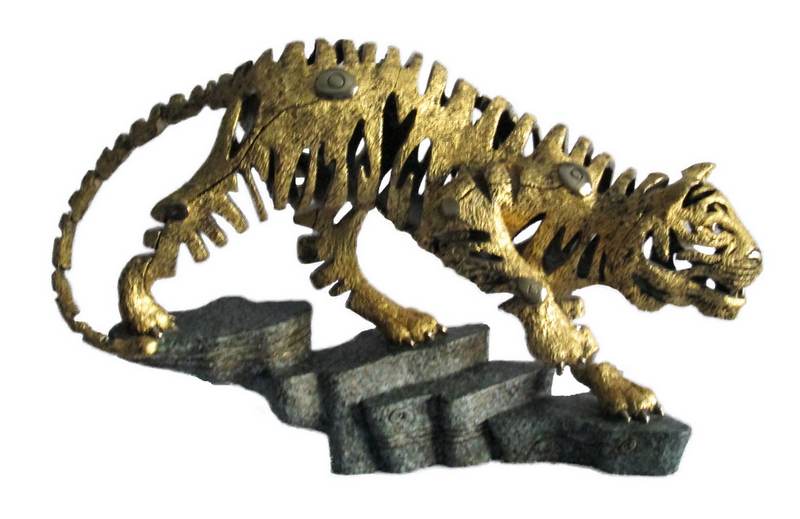
Jiang Tie-Feng his sculptures and art are collected the world over.
Jiang was born in 1938 in Ningbo, Zhejiang Province in China. Even as a child he displayed a great love and talent for painting and drawing. In 1964, he earned his Bachelor of Arts degree from the prestigious Central Academy of Fine Arts in Beijing. Upon graduation, Jiang and a small number of other artists volunteered to go down to the Yunnan province.
From 1966 to 1973, the Chinese Government assigned him to produce "Socialist Realism" propaganda posters and sculptures. Stifled by this sterile exercise, Jiang worked at night on his bed in a small room to create his own style. Along with two other artists, he secretly found what is now known as the "Yunnan School." In 1982, a National Geographic reporter covering life in China, saw Jiang's paintings and brought some back to the United States. Jiang's work was met with great success. In 1983, Jiang came to the United States as part of a cultural exchange program with the University of Southern California. His rich, strong color and exotic but intimate imagery struck an immediate response with the American public. If art is the visual expression of the human spirit, Jiang’s wide popularity has come about because his images strike a universal chord in all of us.
Born in China, Jiang discovered his intense fascination for art as a child.
At age 19 he was accepted to the prestigious Central Art Institute in Beijing. In 1963 he graduated with honors - the last class to be schooled in the traditional Chinese art disciplines due to Mao’s unleashing of his Cultural Revolution. Jiang moved to Yunnan Province where he was forced to create propaganda posters and sculptures. Risking severe punishment, Jiang worked in secret to create his new modern style, rejecting the Red Guards and their "Social Realism".
This was the beginning of the Yunnan School, characterized by the use of bold, heavy colors and abstract imagery. Interwoven into Jiang’s work are symbols illustrating the unique folklore and customs of the minority peoples of Yunnan.
In 1980 Jiang completed a monumental mural that is permanently installed at the Great Hall Of The People in Beijing.
In 1982 the Yunnan School was first exhibited outside communist China in Hong Kong at the Institute Of Art And Design.
In 1983 Jiang came to the United States on an exchange program to teach art at The University of Southern California. Later, in 1984, he permanently moved to America.
Jiang’s themes are universal. His paintings depict primordial human emotions, motherly love, fertility and strength. Jiang feels there are close bonds among all living things and a harmony of peace that we should always strive to achieve.
This website uses cookies to improve your experience. Please review our terms and privacy policies for more info. ACCEPT
Privacy & Cookies Policy
Privacy Overview
This website uses cookies to improve your experience while you navigate through the website. Out of these cookies, the cookies that are categorized as necessary are stored on your browser as they are as essential for the working of basic functionalities of the website. We also use third-party cookies that help us analyze and understand how you use this website. These cookies will be stored in your browser only with your consent. You also have the option to opt-out of these cookies. But opting out of some of these cookies may have an effect on your browsing experience.
Necessary cookies are absolutely essential for the website to function properly. This category only includes cookies that ensures basic functionalities and security features of the website. These cookies do not store any personal information.